Google Images leads our ranking with a score of 9.6/10.

- ✓ Largest image index — 10B+ indexed images
- ✓ Google Lens: reverse search from any photo
- ✓ Circle to Search on Android devices
- ✓ Filter by size, color, type, and license
- ✓ Similar images and shopping integration
- ✓ Real-time object and text recognition

- ✓ Best facial recognition in reverse image search
- ✓ Finds visually similar images, not just exact matches
- ✓ Exceptional for Eastern European and Russian content
- ✓ Clothes, furniture, and product search by image
- ✓ Multiple similar image results per query
- ✓ No account required for unlimited searches

- ✓ Best reverse image search — finds exact matches and duplicates
- ✓ Copyright and image origin tracking
- ✓ Search history — track how images spread online
- ✓ Browser extension for one-click reverse search
- ✓ Mobile image URL upload supported
- ✓ Specialized for image provenance research

- ✓ Visual Search: drag, drop, or paste any image
- ✓ Find similar products with price comparison
- ✓ Identifies landmarks, plants, animals, text in images
- ✓ Microsoft Lens app for mobile image capture
- ✓ Filter by color, style, and product category
- ✓ Integrated with Microsoft shopping ecosystem

- ✓ Shop the Look: find products from any image
- ✓ 1B+ shoppable pins indexed
- ✓ Style and home decor recognition is best-in-class
- ✓ Recommended similar aesthetic boards
- ✓ Object-level search within images
- ✓ Seamless mobile camera integration
In-Depth Reviews
Google Images
#1 Pick
Google Images remains the undisputed champion of general image search, with an index surpassing 10 billion images and a feature set that continues to expand. Google Lens — now integrated directly into the search bar on desktop and mobile — lets you upload any photo, circle any object, or even use your live camera to identify products, plants, animals, landmarks, and text in real time. The Circle to Search feature on Android devices makes it the most frictionless image search experience ever built.
Filter depth is excellent: size, color, image type (photo, clipart, line drawing), and Creative Commons license. For content creators and designers, the license filter alone is worth the visit. Shopping integration surfaces price comparisons directly from image results. No other tool comes close for breadth.
Positive
- ✅ Largest index — finds almost any image ever published online
- ✅ Google Lens identifies objects, text, plants, products instantly
- ✅ Circle to Search is the most seamless mobile image search
- ✅ Deep filter options including Creative Commons license
- ✅ Shopping integration surfaces pricing from images
- ✅ Real-time object recognition in live camera mode
Negatives
- ✗ Results increasingly skewed toward commercial/shopping results
- ✗ Privacy: every image search tied to your Google account
- ✗ Less effective than Yandex for facial similarity matching
Yandex Images
#2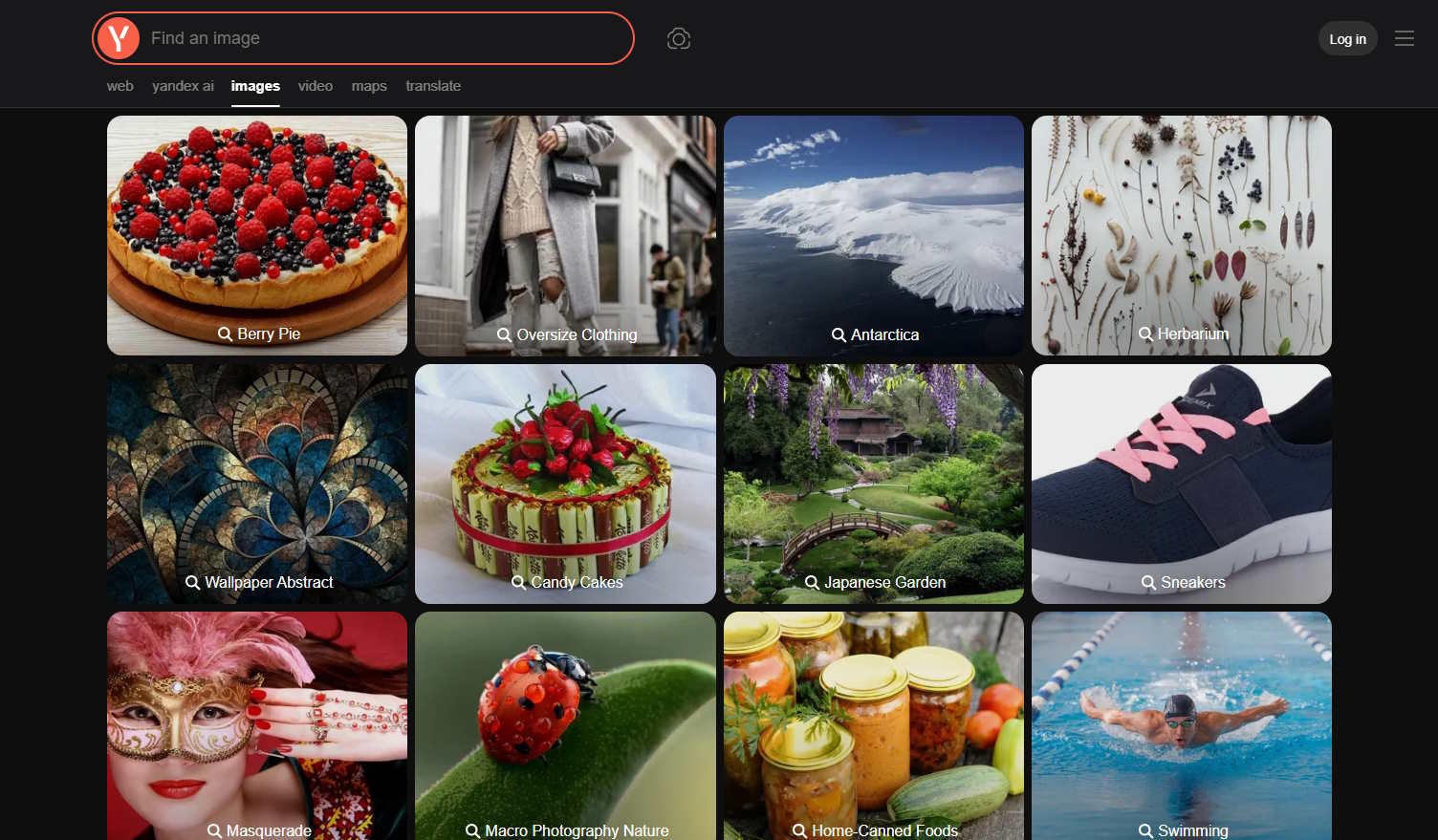
Yandex Images consistently surprises Western users with its facial recognition and visual similarity capabilities. Unlike Google Images which focuses on exact matches or shopping-oriented results, Yandex excels at finding people who look similar, images with comparable visual compositions, and content from Eastern European sources that Google underindexes.
For journalists, researchers, and investigators doing source verification, Yandex Images has become the secondary tool of choice precisely because it surfaces matches Google misses. Clothes and furniture search by image is also notably stronger than Google’s — upload a photo of an outfit and Yandex returns similar products with a precision that regularly beats dedicated shopping tools. The only caveat is that Yandex is a Russian company, which carries obvious geopolitical privacy considerations.
Positive
- ✅ Best facial recognition in reverse image search
- ✅ Finds visually similar (not just exact) image matches
- ✅ Strong for Eastern European and Russian content
- ✅ Excellent clothes, furniture, product search by image
- ✅ No account required for unlimited searches
- ✅ Often finds matches Google completely misses
Negatives
- ✗ Russian-owned — privacy concerns for sensitive searches
- ✗ English UI/UX less polished than Google
- ✗ Index less comprehensive for Western content
TinEye
#3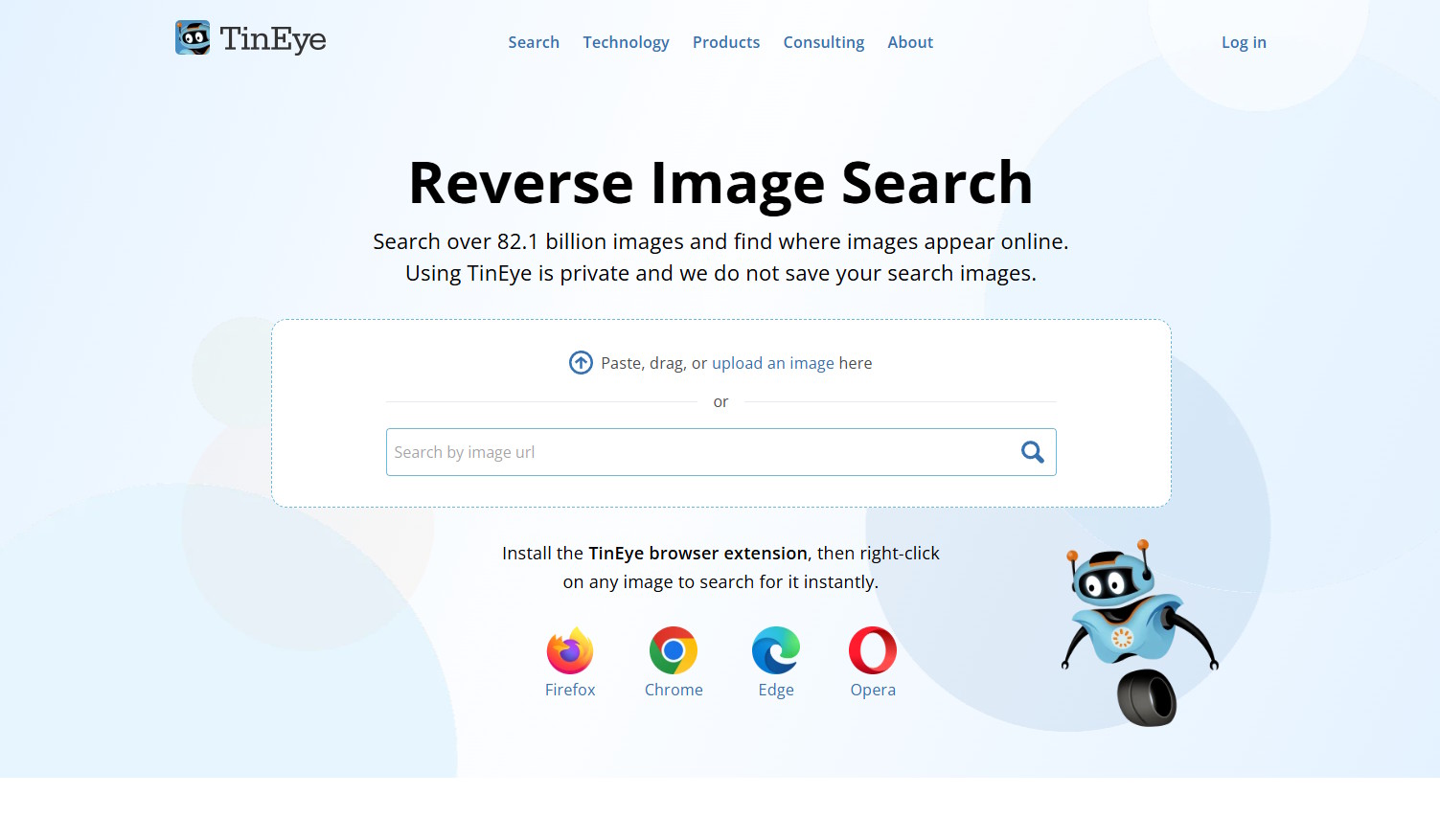
TinEye is the specialist that Google can’t replace. Where Google finds similar images, TinEye finds where an image has been used online — with timestamps, domains, and a trackable history of how an image has spread across the web. This makes it the essential tool for copyright verification, journalism fact-checking, and tracking image provenance.
With over 60 billion images indexed specifically for reverse search, TinEye excels at finding exact and near-exact duplicates. The browser extension makes it a one-right-click operation on any image. For photographers protecting their work, researchers verifying source photos, or journalists confirming image authenticity, TinEye is irreplaceable — it solves a problem Google Images doesn’t even attempt.
Positive
- ✅ Best tool for tracking where an image has appeared online
- ✅ 60B+ images indexed specifically for reverse search
- ✅ Timestamps show when and where an image first appeared
- ✅ Browser extension for instant one-click reverse search
- ✅ Essential for copyright tracking and journalism
- ✅ Most accurate for exact and near-duplicate detection
Negatives
- ✗ Not useful for finding similar-but-different images
- ✗ Narrower use case than general image search
- ✗ API and advanced features require paid plan
Bing Visual Search
#4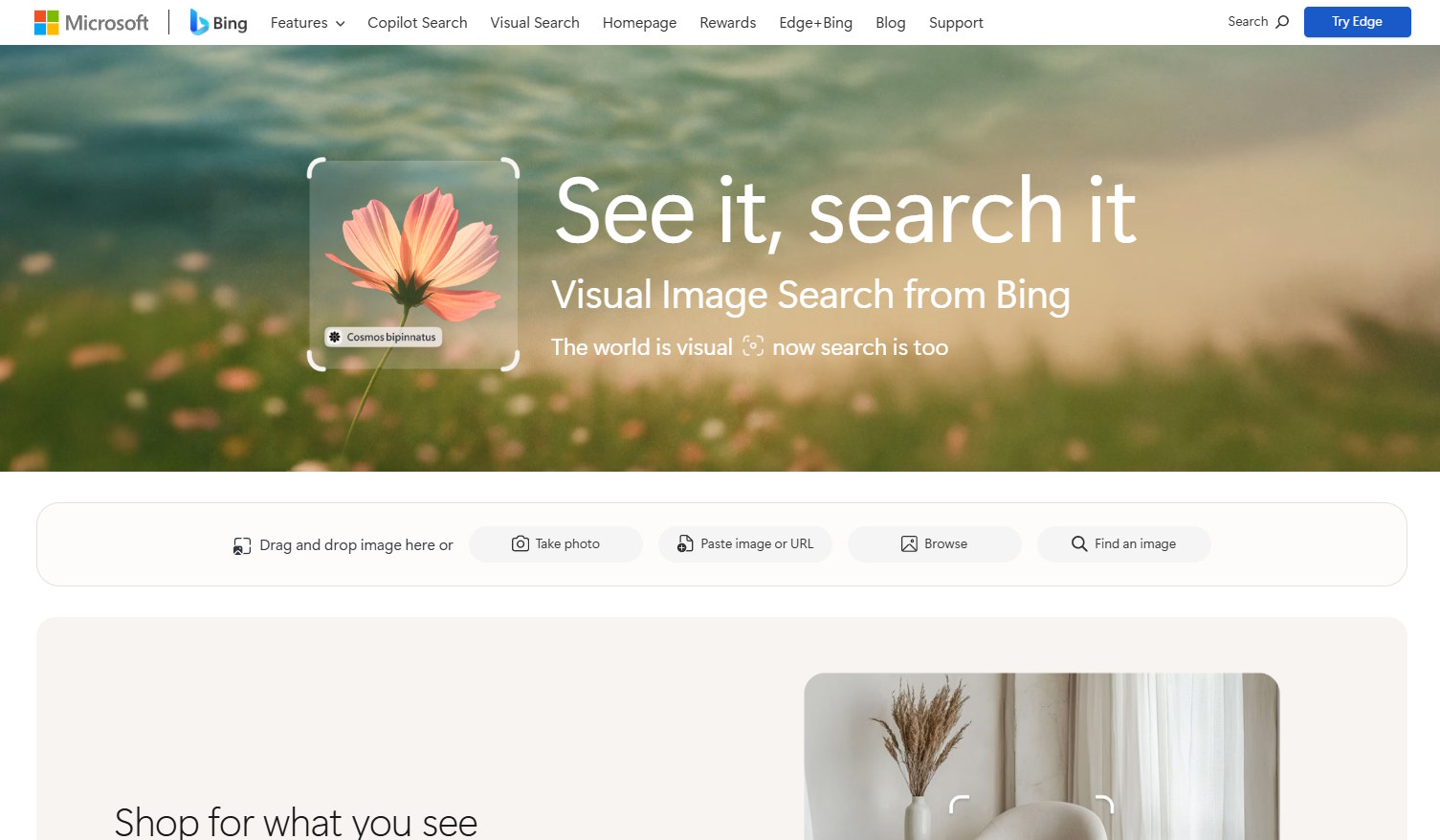
Bing Visual Search has evolved into a capable all-around image search and identification tool, powered by Microsoft’s AI. Drag, drop, or paste any image to identify objects, read text, find similar products, or locate landmarks. The product search is genuinely useful — upload a photo of a lamp, a jacket, or a kitchen fixture and Bing returns similar items with prices from multiple retailers.
The Microsoft Lens mobile app ties into Visual Search seamlessly, letting you photograph physical objects for search. Filter options for color, style, and product category add useful precision. Where it trails Google is index size and where it trails Yandex is facial similarity depth — but for shopping-oriented visual search and product identification, Bing Visual Search sits comfortably at the top tier.
Positive
- ✅ Strong product identification and price comparison from images
- ✅ Drag, drop, or URL paste — most flexible upload options
- ✅ Microsoft Lens app extends visual search to physical objects
- ✅ Identifies landmarks, text, plants, and animals well
- ✅ Integrated with Microsoft shopping comparison
- ✅ Free with no query limits
Negatives
- ✗ Smaller index than Google Images
- ✗ Weaker facial recognition than Yandex
- ✗ Shopping results can over-dominate visual search
Pinterest Lens
#5
Pinterest Lens rounds out our top 5 with solid basic functionality.
Positive
- ✅ Shop the Look: find products from any image
- ✅ 1B+ shoppable pins indexed
- ✅ Style and home decor recognition is best-in-class
Negatives
- ✗ Limited advanced features
Our Testing Methodology
We tested each engine with 80 image queries across 6 types: exact duplicate finding, facial similarity, product identification, landmark recognition, text-in-image extraction, and general visual similarity. Scored on match accuracy (35%), index size (25%), filter depth (20%), speed (10%), and privacy (10%). Reverse image tests used 20 verified source images.