Google Dataset Search leads our ranking with a score of 9/10.

- ✓ 250,000+ datasets from community and competitions
- ✓ Integrated Jupyter notebooks for instant analysis
- ✓ Competitions with prize money and job opportunities
- ✓ Public API for dataset access
- ✓ Dataset versioning and collaborative notebooks
- ✓ Largest ML community with 17M+ members

- ✓ 50,000+ ML/AI datasets ready to use
- ✓ One-line Python dataset loading
- ✓ Model training benchmarks included
- ✓ Community-contributed and institution-published
- ✓ Streaming for large datasets without full download
- ✓ Integrated with Hugging Face model hub

- ✓ Aggregates datasets from 2,000+ repositories
- ✓ Google's semantic search for dataset discovery
- ✓ Schema.org dataset markup indexed
- ✓ Filter by format, license, and update frequency
- ✓ Government, academic, and commercial datasets
- ✓ Free to use — no account required

- ✓ 100+ high-quality datasets hosted on Amazon S3
- ✓ Free cloud egress within AWS — no data transfer costs
- ✓ Petabyte-scale datasets for large model training
- ✓ Earth observation, genomics, and NLP datasets
- ✓ Direct integration with AWS services
- ✓ Registry of Open Data on AWS

- ✓ Official US government open data
- ✓ 300,000+ datasets from 100+ federal agencies
- ✓ APIs for automated data access
- ✓ Census, economic, health, and environmental data
- ✓ Always free — public domain by default
- ✓ Machine-readable formats: CSV, JSON, XML
In-Depth Reviews
Kaggle
#1 Pick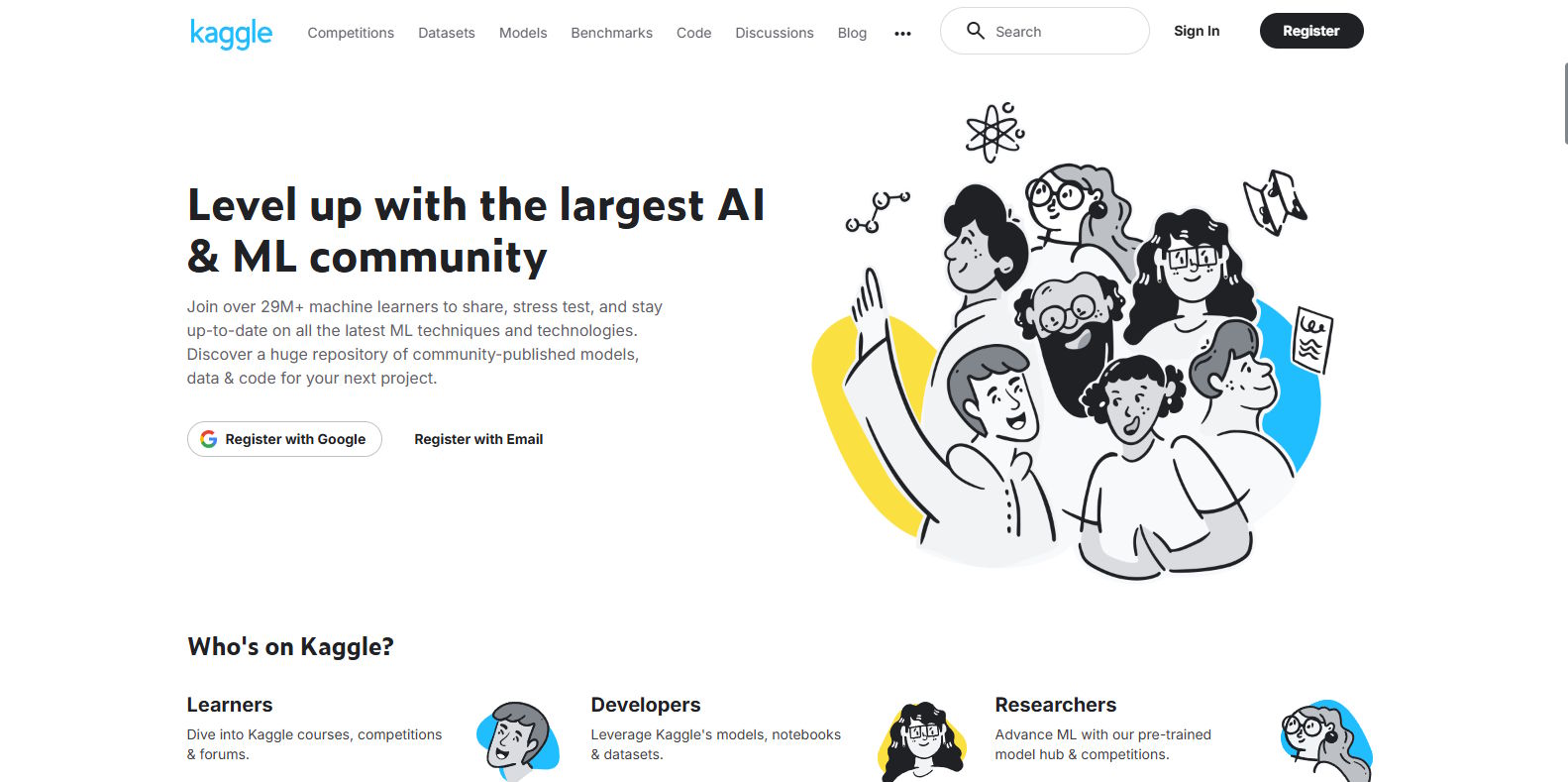
Kaggle is the world’s largest data science community and the go-to platform for ML dataset discovery. With 250,000+ datasets and integrated Jupyter notebooks that start in under 60 seconds, it’s the platform where finding a dataset and starting to analyze it are the same frictionless experience. Competitions with prize money (from $10,000 to $1M+) attract world-class ML solutions that become public learning resources.
Dataset versioning and collaborative notebooks make team data projects practical. The API enables automated dataset access for production pipelines. With 17M+ community members, Kaggle’s discussion forums and kernels provide context, examples, and worked solutions for almost every dataset in the library — making it not just a place to find data but a place to learn how to use it.
Positive
- ✅ 250,000+ datasets with integrated instant notebooks
- ✅ Start analyzing any dataset in under 60 seconds — zero setup
- ✅ Competitions provide state-of-the-art ML benchmark solutions
- ✅ Dataset versioning and collaborative notebooks
- ✅ Public API for automated access
- ✅ 17M+ community for discussion, tutorials, and help
Negatives
- ✗ Dominated by ML/AI datasets — less useful for other domains
- ✗ Account required for dataset downloads
- ✗ Compute-intensive notebooks require paid GPU access
HuggingFace Datasets
#2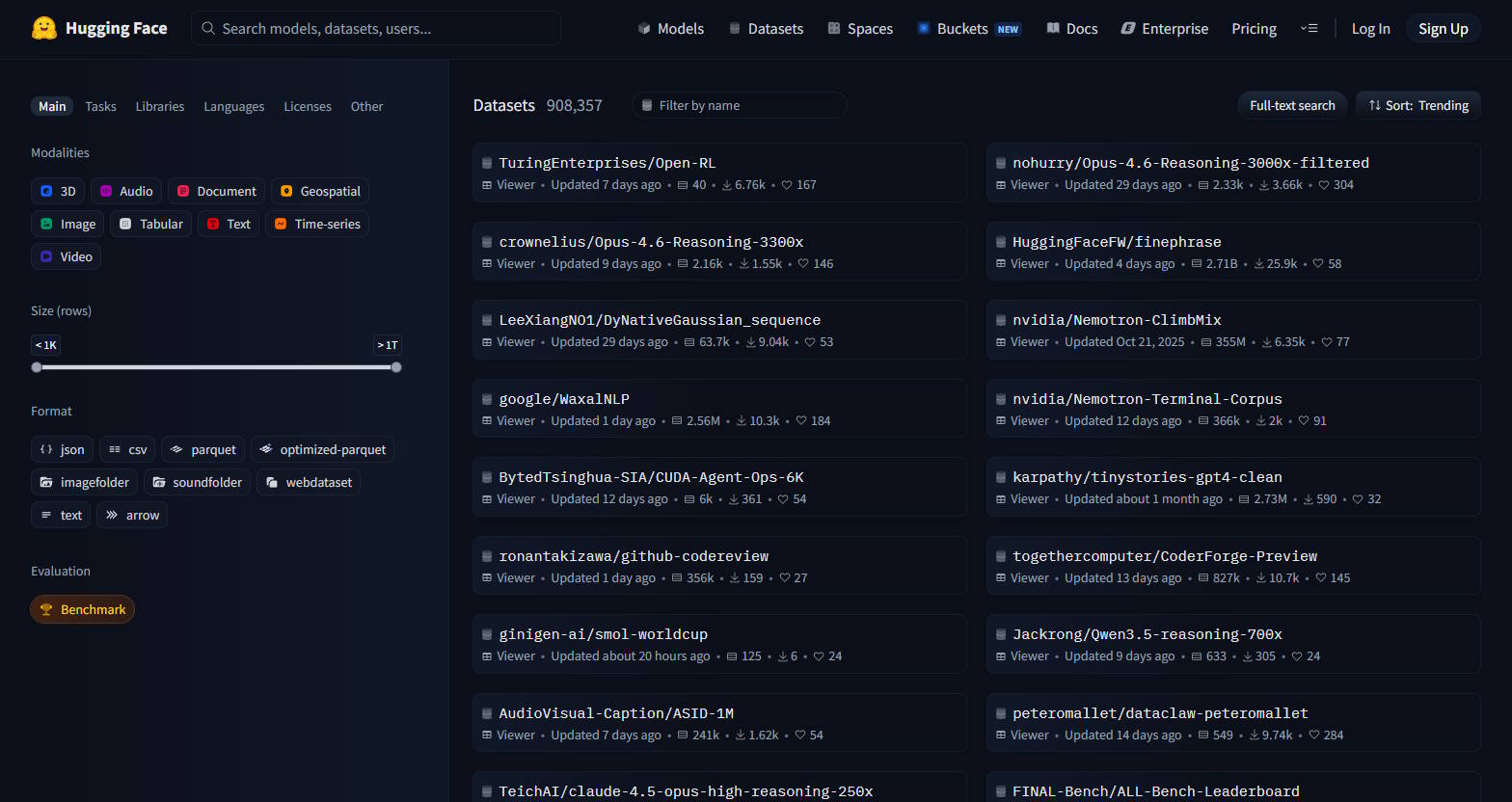
HuggingFace Datasets rounds out our top 5.
Positive
- ✅ 50,000+ ML/AI datasets ready to use
- ✅ One-line Python dataset loading
- ✅ Model training benchmarks included
Negatives
- ✗ Limited advanced features
Google Dataset Search
#3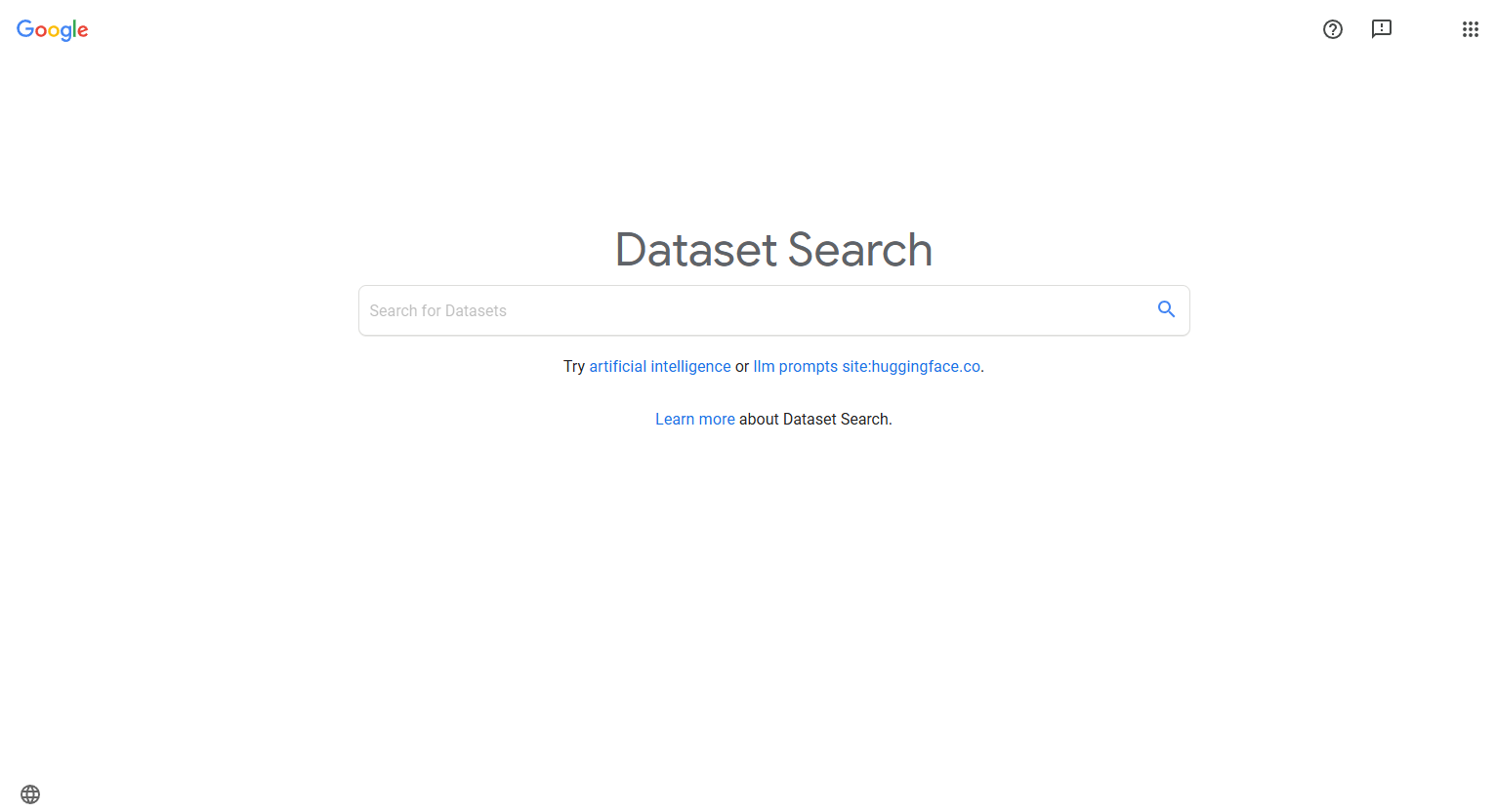
Google Dataset Search indexes 2,000+ dataset repositories using semantic search, making it the broadest starting point for finding any publicly available dataset. The search understands conceptual queries — search for ‘climate temperature records’ and it finds relevant datasets regardless of whether they use that exact terminology. Schema.org dataset markup across academic and government sites is indexed automatically, creating a meta-index of public datasets that no single repository could compile.
Filter capabilities cover dataset format (CSV, JSON, XLS), license type (CC, public domain, restricted), and update frequency. Government, academic institution, and commercial provider datasets all appear in the same search. For researchers and analysts starting a data project who don’t know where their data lives, Google Dataset Search is the fastest way to discover what’s available.
Positive
- ✅ Aggregates 2,000+ repositories — widest dataset coverage
- ✅ Semantic search understands conceptual queries
- ✅ Government, academic, and commercial datasets in one search
- ✅ Filter by format, license, and update frequency
- ✅ Free, no account required
- ✅ Indexed schema.org markup ensures broad coverage
Negatives
- ✗ Discovery only — doesn't host or provide direct data access
- ✗ Metadata quality varies by dataset source
- ✗ No data analysis tools or notebooks
AWS Open Data
#4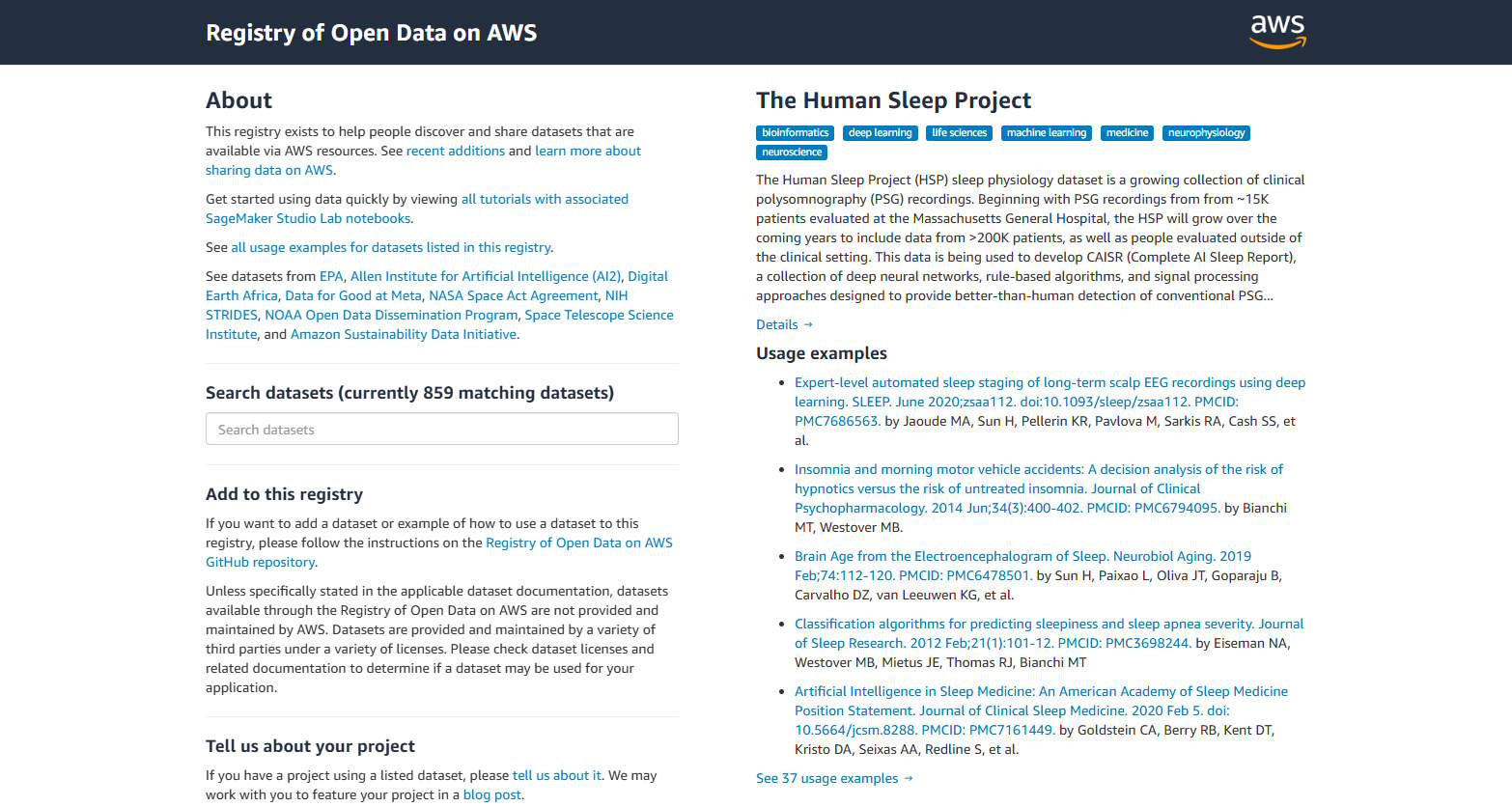
AWS Open Data Registry makes petabyte-scale datasets accessible to researchers and developers at zero data egress cost within AWS — a critical consideration when working with satellite imagery, genomics datasets, or climate models that can reach terabytes in size. With 100+ high-quality datasets spanning earth observation, genomics, NLP training data, and economic datasets, it covers domains that require scale that local downloads can’t support.
Direct AWS integration means datasets can be processed using EC2, SageMaker, or Lambda without moving data between locations. For ML practitioners building large models, the zero-cost access to petabyte genomics or Common Crawl data within AWS is a significant economic advantage. The trade-off is ecosystem lock-in — full benefit requires AWS infrastructure.
Positive
- ✅ Petabyte-scale datasets at zero egress cost within AWS
- ✅ 100+ high-quality curated datasets
- ✅ Earth observation, genomics, NLP, and economic data
- ✅ Direct integration with all AWS ML services
- ✅ Free cloud access — no data transfer costs
- ✅ Ideal for large-scale model training
Negatives
- ✗ Full benefit requires AWS infrastructure
- ✗ Smaller catalog than Kaggle or Google Dataset Search
- ✗ Less community context around datasets
Data.gov
#5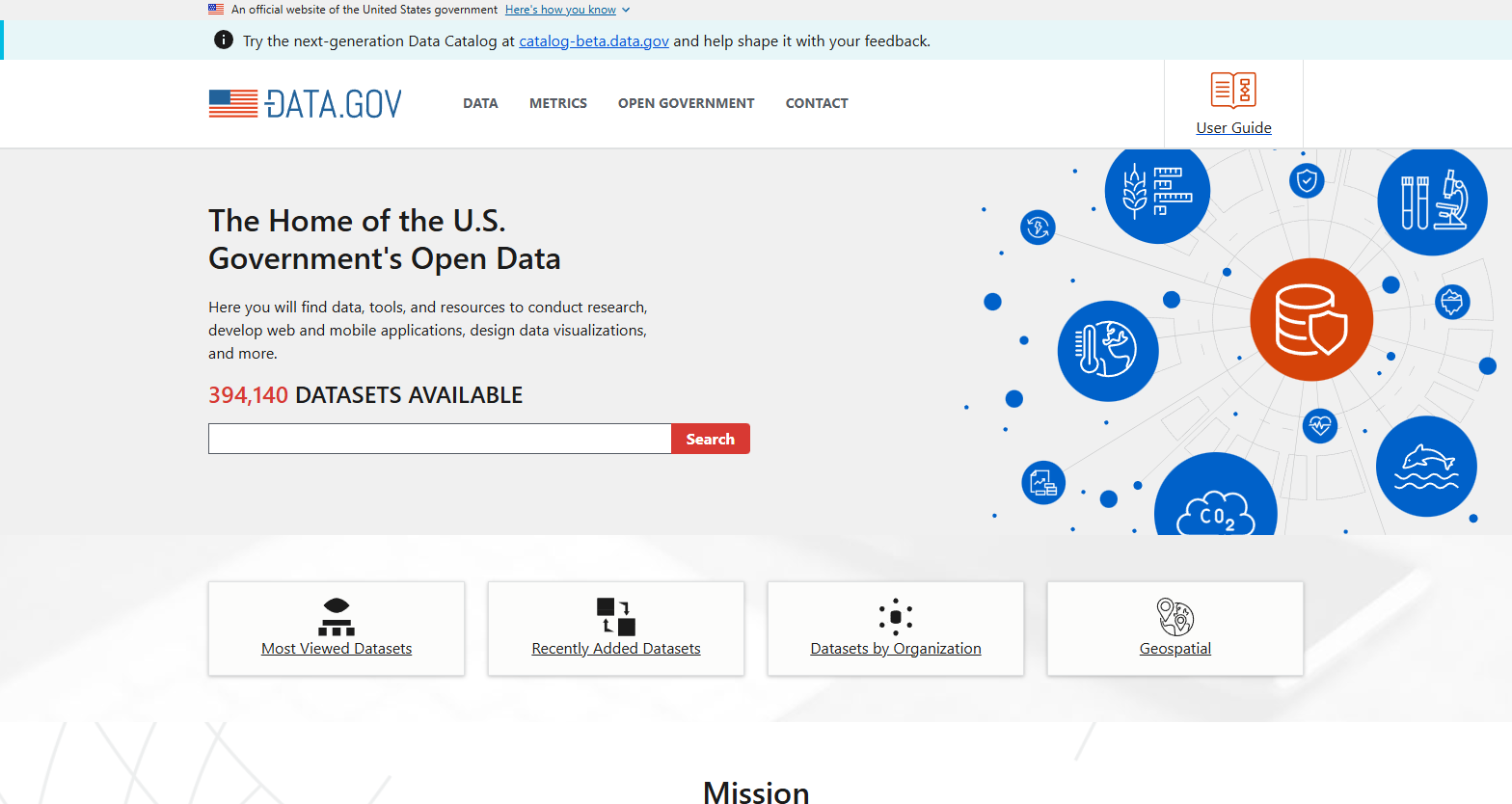
Data.gov is the US federal government’s official open data portal, providing access to 300,000+ datasets from over 100 federal agencies. By definition, all data is public domain and freely usable — no licensing ambiguity. The range covers every domain of government activity: Census demographics, EPA environmental monitoring, HHS health statistics, DOT transportation data, NOAA weather records, and hundreds more.
For researchers, journalists, policy analysts, and civic technologists, Data.gov is the authoritative source for government statistics that appear in academic papers and news articles. The API access for automated data retrieval makes it practical for building data products on top of government data. The limitation is findability — the catalog is broad but search is less sophisticated than commercial alternatives.
Positive
- ✅ 300,000+ datasets from 100+ US federal agencies
- ✅ All data is public domain — zero licensing concerns
- ✅ API access for automated retrieval
- ✅ Census, health, environment, economic data all covered
- ✅ Official authoritative source for US government statistics
- ✅ Free — publicly funded and publicly accessible
Negatives
- ✗ Search quality is less sophisticated than Google Dataset Search
- ✗ Data freshness varies by agency
- ✗ US government data only
Our Testing Methodology
We tested each platform with 20 dataset search tasks: finding ML training datasets, government statistics, scientific measurements, financial data, and text corpora. Scored on dataset volume (30%), search relevance (25%), data access ease (20%), analysis tools (15%), and licensing clarity (10%). Tests conducted by practicing data scientists.