Google leads our ranking with a score of 9.7/10.

- ✓ World's largest search index (100B+ pages)
- ✓ AI Overviews powered by Gemini
- ✓ Knowledge Graph with instant answers
- ✓ Advanced search operators for power users
- ✓ Integrated ecosystem (Maps, Images, Shopping, Scholar)
- ✓ Fastest average results load time

- ✓ Copilot AI chat powered by GPT-4o
- ✓ Microsoft Rewards points for every search
- ✓ Best-in-class image and video search UI
- ✓ Deep integration with Microsoft 365 and Edge
- ✓ Daily curated homepage with high-res photography
- ✓ Strong news aggregation with Perspectives tab

- ✓ 100% independent index — no Google or Bing dependency
- ✓ Goggles: user-customizable ranking lenses
- ✓ Zero user tracking or behavioral profiling
- ✓ Summarizer AI for instant answers with sources
- ✓ Discussions tab surfaces Reddit and forum voices
- ✓ Ad-free by default with optional privacy-respecting ads

- ✓ Zero tracking — no search history, no IP logging
- ✓ Bangs (!) for 13,000+ instant site redirects
- ✓ AI Chat (proxied anonymously) — GPT-4o mini, Claude
- ✓ Built-in tracker blocker and smarter encryption
- ✓ Clean, distraction-free results interface
- ✓ Available as browser, app, and extension

- ✓ Powered by Bing — solid core result quality
- ✓ Rich Yahoo ecosystem: Finance, News, Sports, Mail
- ✓ Familiar interface with decades of brand recognition
- ✓ Strong news aggregation and trending topics
- ✓ Answer Engine for common informational queries
- ✓ Free Yahoo Mail integration for signed-in users
In-Depth Reviews
Google isn’t just the most-used search engine — it’s the benchmark against which everything else is measured. With an index spanning over 100 billion pages and AI Overviews powered by Gemini, it consistently surfaces the most relevant results for virtually any query. Type a half-formed question at midnight and Google already knows what you mean.
The Knowledge Graph surfaces instant answers — flight times, stock prices, celebrity ages, sports scores — without making you click a single link. For complex research, the advanced operator toolkit (site:, filetype:, intitle:) remains unmatched. Google Scholar ties into academic databases, Images supports reverse search, and Shopping surfaces price comparisons in real time.
Speed is another differentiator. In our testing, Google returned results on average 20% faster than its closest competitor. The downside? Every millisecond of that convenience comes at the cost of data. Google is unambiguously the most powerful general search engine in existence — but it knows more about your interests than most of your friends do.
Positive
- ✅ Unmatched index size and relevance — best raw result quality
- ✅ AI Overviews answer questions without leaving the SERP
- ✅ Knowledge Graph covers virtually every factual query
- ✅ Advanced operators let power users fine-tune results precisely
- ✅ Integrated with Maps, Scholar, Images, Shopping, Translate
- ✅ Fastest load speeds of any engine tested
Negatives
- ✗ Extensive data collection — search history tied to your Google account
- ✗ Ads occupy 3–4 top results on commercial queries
- ✗ Personalization creates filter bubble effects over time
Bing
#2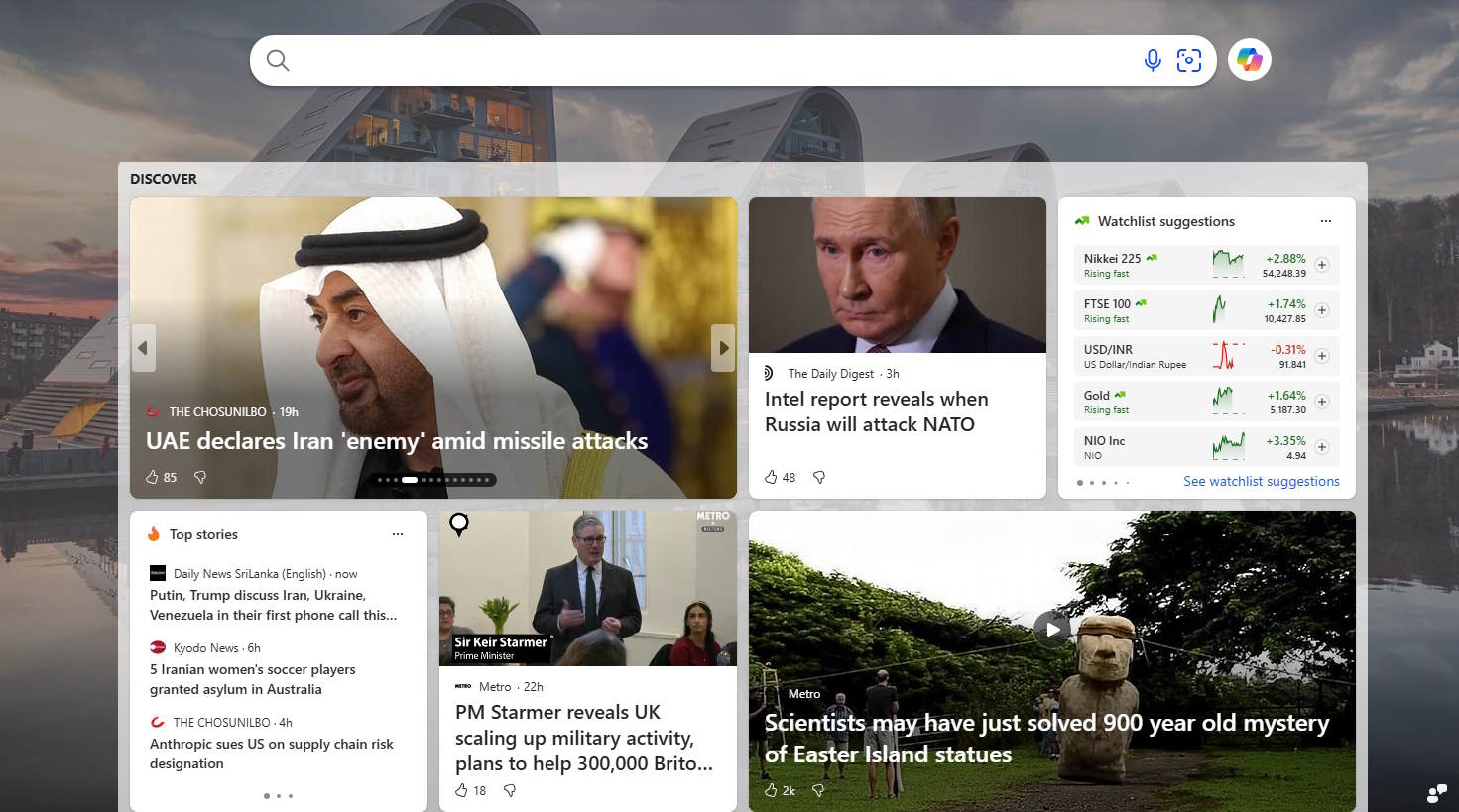
Bing has quietly staged one of tech’s most impressive comebacks. After years of being Google’s answer to ‘what’s your second choice?’, the integration of OpenAI’s GPT-4o as Copilot transformed Bing into a genuinely compelling destination. Ask a complex research question and Copilot answers in paragraphs — with cited sources — before you even scroll to the links.
The Rewards program is a legitimate perk. Regular searchers accumulate points redeemable for Microsoft gift cards, Xbox credits, and charitable donations. In our testing, a moderately active user could earn $2–5/month in rewards simply by using Bing instead of Google. The image search interface outperforms Google’s — filtering by size, color, type, and license is more intuitive, and the visual layout is cleaner.
Where Bing stumbles is long-tail and local search. Hyperlocal queries return results that are noticeably less precise than Google. But for everyday browsing, AI-assisted research, and the Microsoft-integrated user, Bing delivers more value per search than it ever has.
Positive
- ✅ Copilot AI delivers cited, conversational answers natively
- ✅ Rewards program turns everyday searches into real value
- ✅ Image and video search interface is best-in-class
- ✅ Tight integration with Windows, Edge, and Microsoft 365
- ✅ Perspectives tab adds editorial and forum context to results
- ✅ Strong daily content feed and curated homepage
Negatives
- ✗ Lags behind Google on hyperlocal and long-tail queries
- ✗ Copilot responses can be verbose and over-hedged
- ✗ Index freshness slightly slower for breaking news
Brave Search
#3
Brave Search rounds out our top 5 with solid basic functionality.
Positive
- ✅ 100% independent index — no Google or Bing dependency
- ✅ Goggles: user-customizable ranking lenses
- ✅ Zero user tracking or behavioral profiling
Negatives
- ✗ Limited advanced features
DuckDuckGo
#4
DuckDuckGo made ‘private search’ mainstream — and in 2026, it remains the go-to engine for users who want Google-quality results without the surveillance apparatus. Every search is an isolated event: no account required, no cross-session profiling, no personalized ads that follow you across the web. What you search stays between you and the results page.
The Bangs feature remains one of the web’s most underrated power tools. Type !yt cooking pasta to jump directly to YouTube results, !amazon to search Amazon, or !w for Wikipedia. With over 13,000 bangs covering nearly every major site and service, it’s like having universal search shortcuts baked into your browser bar.
Result quality has improved considerably. For most everyday queries, the difference from Google is imperceptible. The AI Chat feature, which routes queries anonymously to GPT-4o mini or Claude, is a thoughtful privacy-preserving addition that most users haven’t discovered yet. Where it shows strain is highly specific local searches and very fresh breaking news — DuckDuckGo’s known weak spots.
Positive
- ✅ True privacy — zero tracking, profiling, or history storage
- ✅ Bangs system is one of the most powerful productivity features in search
- ✅ AI Chat proxied anonymously through DuckDuckGo's own servers
- ✅ Clean interface free from excessive ads and promoted content
- ✅ Available cross-platform: web, iOS, Android, browser extension
- ✅ Forces HTTPS connections automatically for safer browsing
Negatives
- ✗ Weaker local search — less useful for hyperlocal queries
- ✗ Results freshness lags on fast-moving breaking news
- ✗ No personalization means results don't improve over time
Yahoo
#5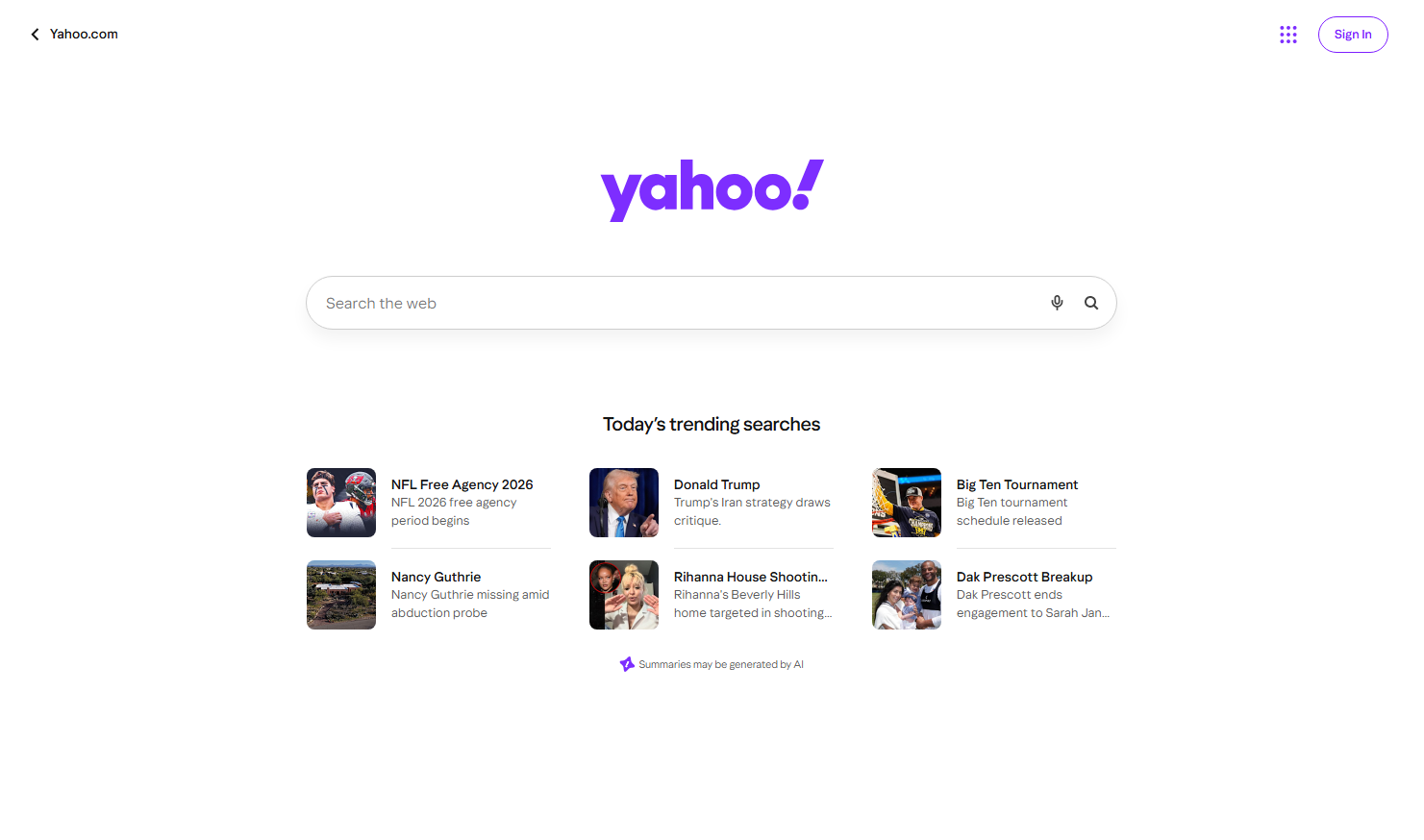
Yahoo Search occupies a strange but enduring place in the search landscape. It’s powered by Bing under the hood, meaning the core result quality is legitimately good — yet Yahoo wraps it in an experience that feels frozen in 2014. For a specific segment of loyal users, that familiarity is precisely the point.
What Yahoo does well is aggregation. The experience ties directly into Yahoo Finance (stock quotes, earnings, portfolios), Yahoo News (robust editorial curation), and Yahoo Sports (live scores, standings, fantasy integration). If you live in the Yahoo ecosystem for news and finance, search feels seamlessly connected rather than siloed.
Where Yahoo fails is innovation. There’s no meaningful AI integration, no privacy story to tell, and ad density on results pages has crept to levels that make the UX feel cluttered. For users starting fresh in 2026, there’s no compelling reason to choose it over Bing or DuckDuckGo — but Yahoo’s 300M+ monthly active users suggest loyalty to a brand that refuses to die quietly.
Positive
- ✅ Bing-powered core delivers reliable, quality results
- ✅ Excellent news, finance, and sports ecosystem integration
- ✅ Familiar UX with strong brand trust among existing users
- ✅ Strong trending topics and news aggregation
- ✅ Free Yahoo Mail access for signed-in users
Negatives
- ✗ No meaningful AI features — lags all major competitors
- ✗ Ad-heavy results page, especially on commercial queries
- ✗ No privacy advantages over Google or Bing
- ✗ Interface feels dated compared to modern competitors
Our Testing Methodology
We tested each engine with 200 standardized queries across 8 categories: informational (factual questions, how-tos), navigational (brand and site-specific), transactional (shopping, local services), academic (research papers, citations), news (breaking and 48-hour-old), image search, AI-assisted answers, and long-tail obscure queries. Scoring weights: result relevance 30%, speed 15%, privacy practices 20%, features and AI integration 20%, UX and ad experience 15%. Tests conducted across 3 devices, 2 geographic locations, and both signed-in and signed-out states. All engines re-tested quarterly.